

Why AI is Important for DME Companies
.png)
Running a DME company has never been simple. The administrative side of running a DME company is a lot to manage. Compliance rules shift. Denial rates climb. Patient volumes grow. And the expectation to handle it all with leaner teams isn't going away.
That's where AI comes in. Across the DME industry, artificial intelligence is moving from "nice to have" to an operational necessity. DME AI automation is helping suppliers cut through the paperwork, catch billing errors before they become denials, and deliver a better patient experience. This guide breaks down exactly how.
Key Benefits AI Can Provide for DME Companies
At its core, AI processes large volumes of structured and unstructured data. Often, it's faster and more accurate than manual workflows. For DME suppliers, that means fewer errors, cleaner claims, faster reimbursements, and more time for staff.
The benefits fall into three main categories: revenue cycle and billing performance, operational efficiency, and patient care.
Revenue Cycle & Billing
Revenue cycle performance is a top priority for most DME suppliers. It's also where the pressure is highest and where the most money is quietly slipping through. Denials, underpayments, and documentation gaps are chronic, expensive problems. Addressing them requires visibility across every stage of the cycle.
1. Claims Processing and Denial Management
Ask any DME biller what keeps them up at night, and denied claims are probably near the top of the list. A missing modifier here, a mismatched diagnosis code there. Small oversights that are easy to miss with high volumes, and costly when they slip through.
AI claim scrubbing runs in the background before anything goes out. It cross-checks each claim against payer rules, coverage requirements, and documentation standards. Problems get flagged early. Your team fixes them before submission, not after a denial comes back.
There aren't enough hours in the day for billing teams to manually review every claim at that level of detail. The real value is simple: give your team a tool that catches what's easy to miss. One that scales with your volume, no matter how busy things get. Fewer denials, faster payments, and less time spent on resubmissions.
The right AI powered qualification solution handles this in real time. Issues get caught on the front end, where they're easy to fix. Waiting until the back end means lost time and revenue.
2. The AI Billing Assistant
DME billing codes aren't simple. The right HCPCS code depends on whether equipment is rented or purchased, new or used, a replacement, and which payer is involved. Getting it wrong means hours of rework and potential compliance headaches down the road.
AI coding tools take a lot of that pressure off billing staff. They suggest the right codes and modifiers based on physician orders, clinical documentation, and payer rules. Less guesswork, fewer errors, faster turnaround.
When denials happen, AI can help build appeal letters too, pulling together the right documentation and structuring the argument to match what the payer wants to see. Billing software has come a long way from basic record-keeping. Today it's handling some of the most time-consuming parts of the job.
3. Recovering Lost Revenue
Not every revenue challenge shows up as a denial. In some instances, payers simply pay less than they should. These underpayments are easy to miss and catching them means comparing every remittance against contracted rates and Medicare allowables, line by line. That's a lot to keep up with manually.
AI tools have the ability to take that off your plate. They reconcile payments automatically, flag the gaps, and surface money that would otherwise get written off. That's revenue your team already earned, but might never have collected.
Efficiency & Operations
Beyond billing, AI is reshaping day-to-day DME operations. Two of the biggest efficiency gains involve documentation processing and inventory management.
1. The End of the Paper Trail
DME suppliers manage enormous volumes of paperwork. Physician orders, insurance verifications, delivery receipts, prior authorizations add up fast. Much of it arrives by fax, arrives incomplete, or requires manual review before moving through the workflow.
Anyone who has worked in DME knows how quickly a documentation problem can spiral. One missing field or signature can hold up an entire order. And if it slips through to billing undetected, you're dealing with a denial that didn't have to happen.
Intake automation solves this at the source. It captures incoming documents from fax, email, and mail and pulls out the key data fields automatically. This includes handwritten or unstructured records too. No manual keying. From there, any gaps get flagged before the order moves forward. Problems get caught early, before they have a chance to slow things down. The goal is to ensure data integrity at the front end, making the rest of the revenue cycle seamless.
2. Predictive Stocking
Inventory is one of those things that's hard to get right. Order too much of the wrong equipment and you have cash sitting on shelves. Order too little of what patients actually need and you're scrambling to fulfill orders or pushing back delivery timelines.
Predictive tools give suppliers a clearer read on demand. They have the ability to analyze referral patterns, seasonal trends, and patient demographics. Nothing guarantees perfect accuracy, but the visibility alone changes how suppliers plan.
Patient Care & Product Innovation
Operational efficiency is the obvious win. But AI is also changing the day-to-day patient experience, from how equipment gets configured to how patients get answers to basic questions.
1. Personalized Care at Scale
A lot of DME involves equipment that needs to be dialed in to each patient. CPAP pressure settings, oxygen flow rates, and wheelchair controls all require individual configuration. Traditionally, that meant waiting for a patient to call in and report a problem before anyone made an adjustment.
AI flips that around. Connected equipment generates a constant stream of data. Think of this as an early warning system. When something's drifting, suppliers can catch it before the patient does. At scale, that visibility translates into fewer returns, stronger patient outcomes, and referral relationships built on consistent follow-through.
2. Using AI Chatbots to Guide Patients
Patients coming to a DME provider for the first time usually have a lot of questions. What equipment do they actually need? Will their insurance cover it? A well-designed DME chatbot handles the basics automatically. It helps patients understand their coverage and guides them through equipment setup. Basic intake information gets collected before anyone on staff needs to step in. Complex questions get routed to the right person, so nothing falls through the cracks.
Summary of the Benefits AI Provides to DMEs
Suppliers who’ve invested in AI for their operations are seeing measurable results across their workflows:
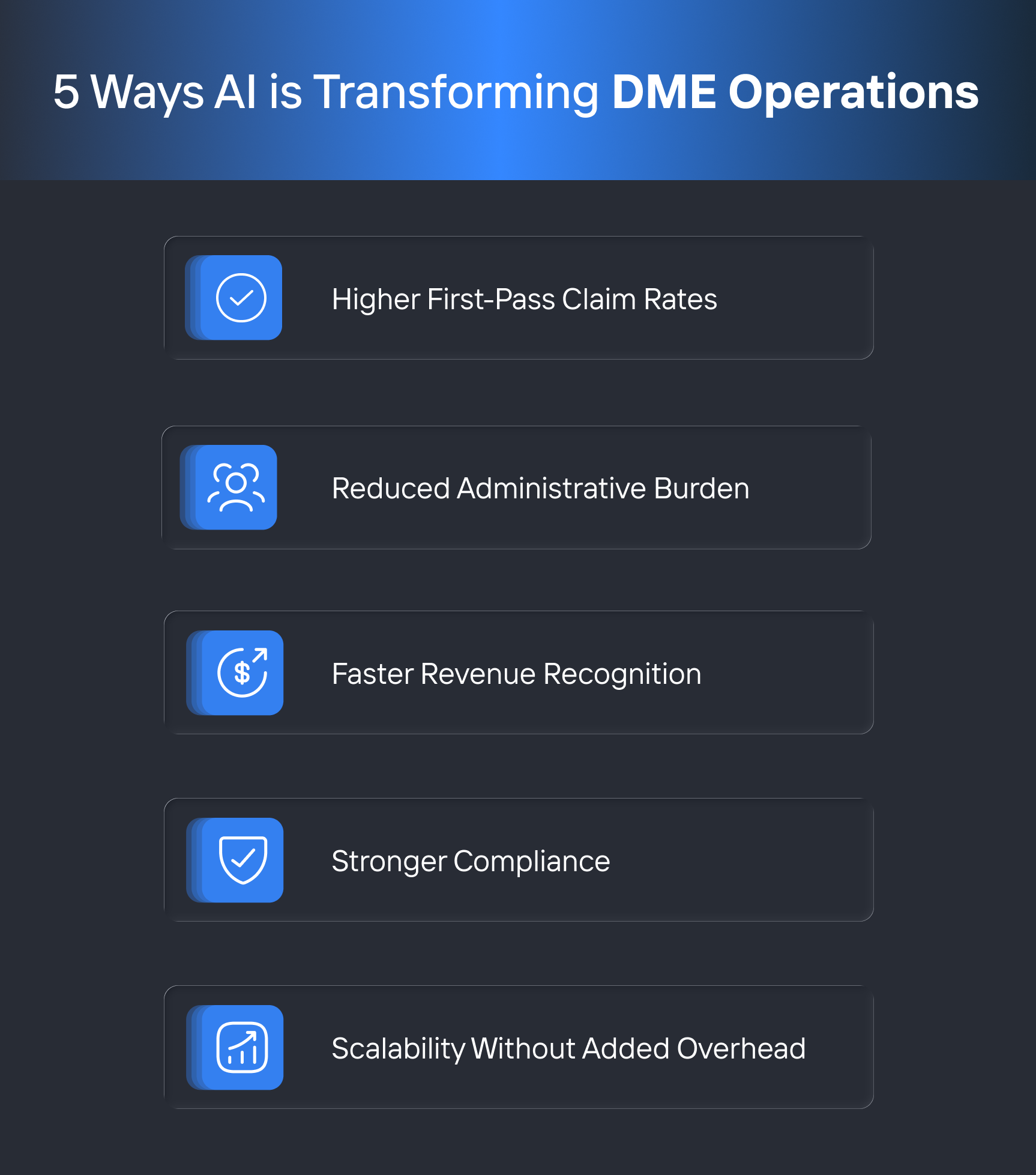
- Higher first-pass claim acceptance rates: Fewer claims come back denied, which means faster payment and less time spent fixing and resubmitting
- Reduced administrative burden: Repetitive tasks get handled automatically, so billing staff can spend their time on work that actually requires their expertise
- Faster revenue recognition: Claims go out the door faster and denials don't sit around waiting to be worked
- Stronger compliance: Rules get applied the same way every time. No human error, no missed requirements
- Scalability without proportional headcount growth: Volume can grow without the team having to grow at the same pace
The DME industry is changing fast. Staffing is harder. Reimbursement is tighter. Compliance demands keep growing. The good news is that the tools to tackle these challenges are already here and they're more accessible than ever.
If you're looking for a place to start, Notable Systems offers AI-powered automation built specifically for DME and HME operations. From intelligent document intake to real-time payer compliance checks, our tools are designed to fit into your existing workflows and make the day-to-day a little easier to manage. Learn more at notablesystems.com.