

How to Map Your DME Operations for Automation
Automating DME Workflows: Where to Start
AI and automation in the DME space is often thought of as a single capability: a tool you flip on and suddenly everything runs faster. Then implementation starts, and the tool doesn’t quite look how you imagined it.
The challenge with DME workflow automation is that no two operations are identical, and neither is the way AI fits into them. Some processes should be completely automated. Some should be eliminated entirely. Some processes need human judgment sitting alongside the technology and some should stay human-only because that's where your business actually lives.
Understanding which of your processes belongs in which category is key to finding value with AI.
The Four Workflow Buckets
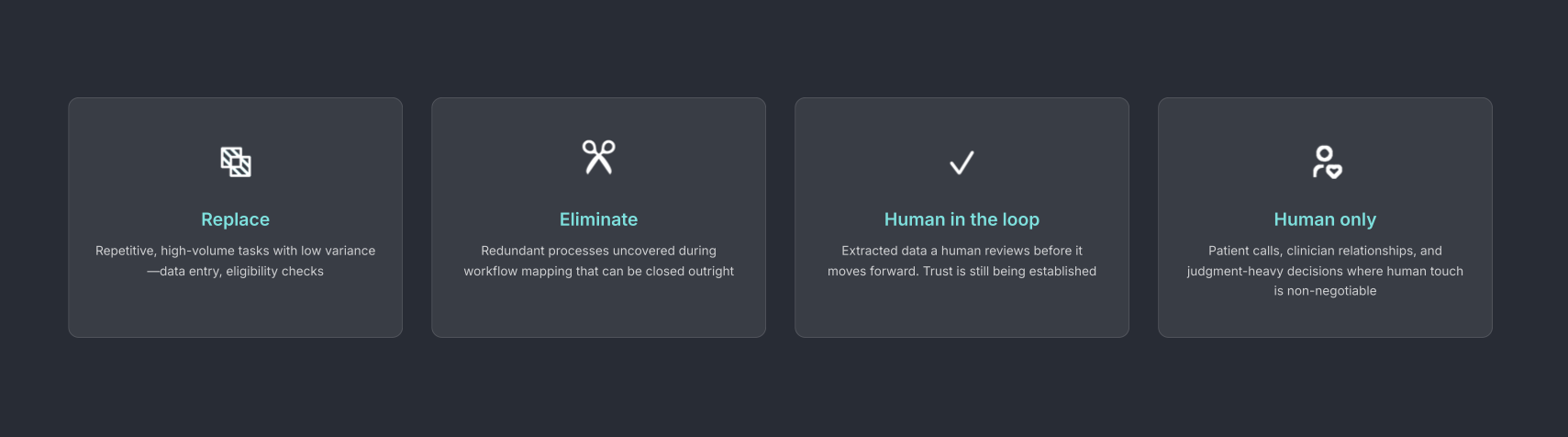
During workflow mapping, every step in your referral-to-cash process should be classified into one of four buckets before AI implementation.
Replace
These are repetitive, high-volume tasks with low variance: data entry, eligibility checks, OCR pulling clean structured data from intake forms, Robotic Process Automation handling the click-by-click navigation into payer portals. These tasks are tedious for your team but structurally simple. They tend to follow a consistent, predictable path.
Automation within this bucket is straightforward. The ROI case is built on replacing tasks. This is where hours of work can be recovered: the work your team currently spends on tasks that don't require judgment, just attention to detail.
Eliminate
During workflow mapping, you'll find redundant processes that exist simply because they're how things have always been done: duplicate entry points, steps that no longer serve a business function, workarounds that made sense a few years ago but now just add friction.
These are redundant processes uncovered during workflow mapping that can be closed outright.
Human in the Loop
This bucket is where you manage risk. "Human in the loop" tasks are extracted data that a human reviews before it moves forward. Trust is still being established with the vendor and the system. A Large Language Model reads your medical record against a payer's coverage criteria and flags whether documentation supports the authorization. Your clinical reviewer sees the AI's work and validates it.
This bucket is the bridge between learning to trust this system and the system doing this reliably. The level of human oversight will evolve over time. Some organizations start with 100% human review of AI-extracted data, which is a reasonable choice, but the goal shouldn't be permanent review.
The harder question is: What accuracy threshold makes human review unnecessary for a given field? If the AI is pulling a specific demographic field correctly 99.5% of the time, what is the cost of the 0.5% error rate compared to the cost of reviewing every record? That answer will be different for every field and every organization.
The real value of implementing AI is sometimes misunderstood as cost reduction and time savings. Take a look at your team on the ground level. When you remove the eligibility checks and record reviews from someone's plate, they can take the time to listen to patients instead of juggling twenty records at once. They can have an empathetic conversation instead of rushing through the process. That's the value proposition that matters to staff: the tangible ability to give patients the full attention they deserve.
Human Only
These are the critical areas that matter most to your business where you absolutely want human involvement: patient calls, clinician relationships, and judgment-heavy decisions where the human touch is the service itself. This is where your business thrives.
Your referral sources evaluate you on people, not processes. The calls that solve patient problems and the relationships that drive repeat orders are the moments that define your service and shouldn't be touched by automation.
The Value Behind the Framework
Mapping these four buckets is key to a successful implementation. It allows you to see into all the exceptions, workarounds, and institutional knowledge living in people's heads. The SOP that documents your process is often three paragraphs instead of ten pages, and it describes how work should flow.
Mapping forces you to see the real work. When you move through each workflow step and ask which bucket each step belongs in, you're getting a clear view of how your operations actually move.
The “replace” and “eliminate” buckets are where you build your ROI case. The “human in the loop” bucket is where you manage risk. The “human only” bucket is where you protect the relationships and judgment that no technology should touch.
Know Your Operations First
This mapping exercise doesn't require perfection. Map the happy path that covers the majority of your claim volume. Edge cases, such as workers' comp claims, auto orders, and the two unusual payers you see twice a year, aren't worth designing around at this stage.
The core workflow is worth mapping in detail: the referral through intake, eligibility, authorization, and submission. As you map, ask this one question at each step: Which bucket does this belong in?
- Replace
- Eliminate
- Human in the loop
- Human only
Implementing automation starts with clarity about what your operations actually need. Everything else builds from that foundation.